
Where the double-headed eagle comes from
The double-headed eagle is older than Albania as a state. As a sign of rule it appears in the Byzantine Empire, above all in its late period under the Palaiologos dynasty. From there the motif travelled through marriages, alliances and court culture to the princely and noble families of the Balkans. Serbia, later Russia and the Holy Roman Empire also carried a double-headed eagle, each in its own colours and with its own meaning.
For the Albanian noble houses of the fourteenth and fifteenth centuries, the eagle was a mark of rank and origin. Several families carried it in their arms, among them the Kastrioti from the north of today's Albania. From this house came the man who turned the eagle into the sign of an entire people.
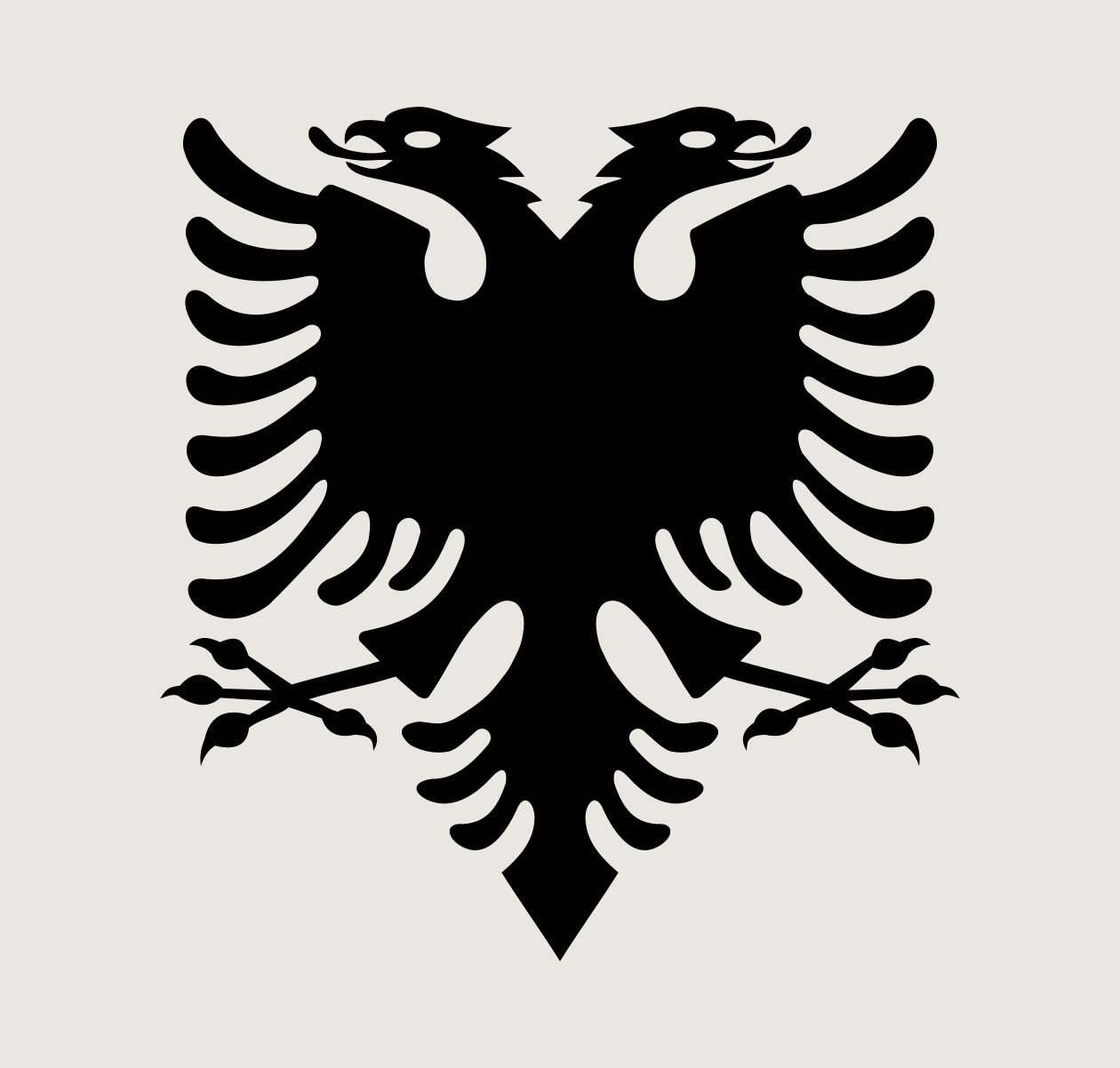
Skanderbeg and the red banner
Gjergj Kastrioti was born in 1405 and came to the court of the Ottoman sultan as a young man. There he rose through the army and was given the name Iskender Bey, which became Skanderbeg. In 1443 he returned to Krujë, changed sides and, according to tradition, raised a red banner bearing the black double-headed eagle of his family.
In 1444 the Albanian princes joined forces under his leadership in the League of Lezhë. For twenty-five years Skanderbeg held out against the Ottoman armies, until his death in 1468. In that time the eagle on red became the sign of resistance, and it stayed one in songs, stories and pictures through the centuries in which there was no Albanian state.
The helmet and sword attributed to Skanderbeg are, by the way, in Vienna: in the Imperial Armoury of the Kunsthistorisches Museum. The helmet is crowned with a goat's head of gilded copper. It is this helmet that sits above the eagle in Albania's coat of arms today.
28 November 1912: the eagle becomes the flag
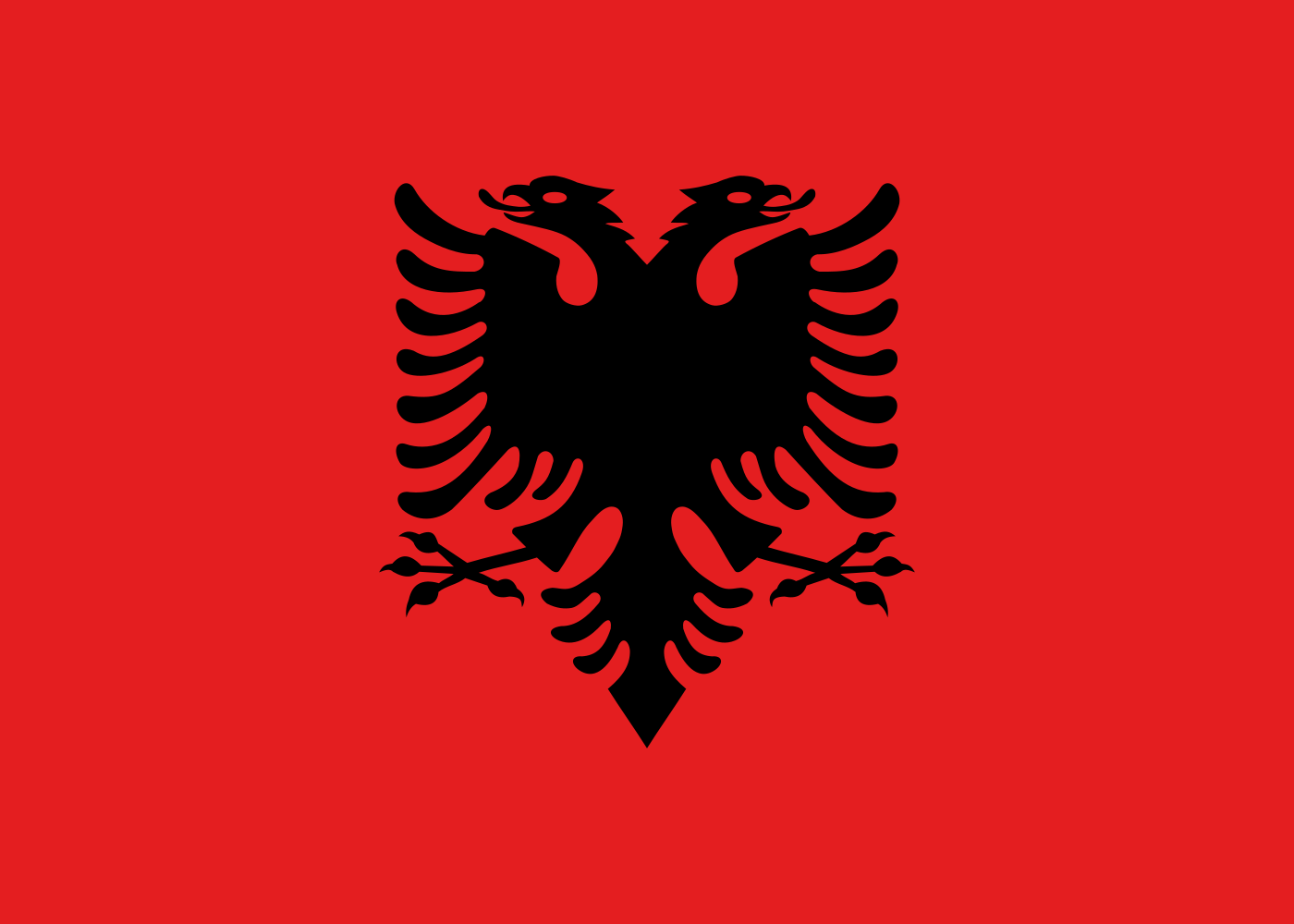
After more than four centuries of Ottoman rule, Ismail Qemali declared Albania's independence in the port city of Vlora on 28 November 1912. The flag raised that day showed the black double-headed eagle on red, deliberately the colours of Skanderbeg. Since then 28 November has been both Independence Day and Flag Day, in Albanian Dita e Flamurit.
The flag changed with every regime. Under King Zog, Skanderbeg's helmet was placed above the eagle. During the Italian occupation in the Second World War, fascist emblems were added, and after the war the communist regime put a red star outlined in yellow above the heads. On 7 April 1992, after the end of communism, the star was removed. Since then the flag again shows only what it showed in 1912: the black eagle on red.
Beyond Albania, too, it is the flag of Albanians. Kosovo has had its own state flag since 2008, blue with a golden map and white stars, but in everyday life, at weddings and in the stadium it is usually the double-headed eagle that flies. The same goes for the Albanian communities in North Macedonia and Montenegro and for the diaspora from Zurich to Stuttgart.
What the colours and the two heads mean
There is no official interpretation, but there is one that almost every family knows. The red stands for courage, strength and the blood shed for freedom; the black of the eagle for steadfastness. And the two heads, looking left and right, are often read as a gaze to the east and to the west: a country between worlds that keeps both in sight.
Historically, that reading came later. In Byzantium the double-headed eagle is usually interpreted as a claim to rule over east and west. For Albanians its meaning shifted over the centuries: away from an emperor's sign of power, towards the sign of a people that would not be broken.
Shqiponja: is the eagle in the name?
In Albanian the eagle is called shqiponjë, in its definite form shqiponja. Albania is Shqipëria, and Albanians call themselves Shqiptarë. The resemblance is so striking that the explanation “land of the eagles” has spread widely: in travel guides, on souvenirs and in many families.
Linguists take a more sober view. Most Albanologists derive Shqipëria from the verb shqipoj, “to speak clearly, to make understood”. Shqiptarë would then be those who speak the same language: Shqip. The eagle derivation is considered a folk etymology. For the meaning of the symbol that hardly matters; if anything, it shows how deeply the eagle is rooted in the way Albanians see themselves.
The gesture: an eagle made of two hands
Today the eagle is most visible without fabric or colour: you cross your hands in front of your chest, hook your thumbs together as the necks and spread your fingers as the wings. The gesture belongs at weddings, concerts and photos, and above all in the stadium. Since the big tournaments, almost every football fan knows it, far beyond the diaspora.
For many it is a greeting among compatriots, a sign that says: I know where I come from. Like any national symbol it can be read as a provocation in tense moments. In the vast majority of cases it is meant simply as pride.
Why the eagle belongs in leather
BARDH & GENT is made for people who grew up with this eagle: on the wall at their grandparents', on the scarf in the stadium, on the car on the long drive south in the summer holidays. Most of them live in Switzerland, Germany or Austria today.
That is why we do not print it in gold across the chest. On the Dardania leather jacket the double-headed eagle is pressed 300 millimetres wide across the whole back, tone on tone on the black jacket. It only shows when the light moves across it. Those who know it will see it. Everyone else does not have to.

The Dardania leather jacket carries the double-headed eagle across the back: 300 millimetres wide, pressed into scale-grain leather. No print, no patch. Numbered, in black and bone white.
SEE THE JACKET →Why does the Albanian eagle have two heads?+
The double-headed eagle comes from Byzantine symbols of rule and reached the Kastrioti family and Skanderbeg through the nobility of the Balkans. In popular tradition the two heads are read as a gaze to the east and to the west.
What does shqiponja mean?+
Shqiponja is Albanian for “the eagle”. That Shqipëria means “land of the eagles” is a widespread folk etymology; linguists usually derive the name from shqip, the Albanian language.
Since when has the Albanian flag existed?+
As the national flag since independence on 28 November 1912 in Vlora. Its model is Skanderbeg's banner from the fifteenth century. The current form without a star has applied since 7 April 1992.
What do red and black stand for?+
There is no official interpretation. The common reading is red for courage, strength and the blood shed for freedom, black for steadfastness.
- Wikipedia: Flag of Albania
- Wikipedia: Names of the Albanians and Albania
- Wikipedia: Skanderbeg
- Wikipedia: Double-headed eagle
- Kunsthistorisches Museum Wien: Skanderbeg, Imperial Armoury
The bell-shaped xhubleta, the white felt plis and the pleated fustanella: three garments of Albanian traditional dress, how they are made and what they mean.
READ →Besa means the given word, and for Albanians it is sacred. What the word means, how it shaped history and why it saved Jewish lives in the Second World War.
READ →Why Albanians celebrate on 28 November, what happened in Vlora in 1912, how the November holidays fit together and how the day is marked from Tirana to Stuttgart.
READ →