
From hostage to the sultan's officer
Gjergj Kastrioti was born around 1405 as a son of Gjon Kastrioti, a lord in the north of today's Albania. Like many Balkan princes of his time, his father had to bow to the rising Ottoman Empire, and like many princely sons Gjergj was sent to the sultan's court as a hostage, a guarantee of his family's loyalty.
There he was educated at the palace school, the Enderun, which trained officers and administrators for the empire. He became a Muslim, served Sultan Murad II for some twenty years and rose through the ranks. The Ottomans called him Iskender Bey, Lord Alexander, in reference to Alexander the Great. In 1440 he was appointed governor of the Sanjak of Dibra, a district close to his family's lands.
1443: the change of sides
In 1443 a Christian army under the Hungarian commander John Hunyadi defeated the Ottomans near Niš. Skanderbeg used the confusion of the battle to leave the Ottoman army with a group of Albanian followers. He rode to Krujë, the fortress of his family, took it and, according to tradition, raised a red banner with the black double-headed eagle. He returned to the Christian faith.
In March 1444 he brought the Albanian noble families together in Lezhë. The League of Lezhë was the first time the small, often feuding Albanian principalities acted together. Skanderbeg became its military leader. Only a few months later came the first test: at the Battle of Torvioll in 1444, his army of around 15,000 men defeated an Ottoman force of around 25,000.
Twenty-five years of resistance
Over the following years the sultans sent army after army. In 1450 Murad II himself, together with his son and heir Mehmed II, laid siege to Krujë. Skanderbeg left a garrison of 4,000 men in the fortress under his trusted commander Vrana Konti and harassed the besiegers from the mountains, attacking their camps and supply caravans. The siege failed.
His tactics were those of a commander who knew both sides: small, fast units, intimate knowledge of the terrain, sudden attacks and rapid retreats. Mehmed II, who took Constantinople in 1453, also failed to take Krujë in his campaigns of the 1460s. At the same time Skanderbeg sought allies in the west, in Naples, Venice and Rome. In the early 1460s he even crossed to southern Italy with troops to support King Ferdinand of Naples.
Death in Lezhë
Skanderbeg did not die in battle. On 17 January 1468 he died of malaria in Lezhë, at the age of about 62. His son Gjon was too young to take over his father's role. Without its leader, the resistance slowly crumbled. Krujë, defended by then by Venice, fell in 1478 after a fourth siege, ten years after his death. Today a memorial in Lezhë marks the place where he was buried.
From commander to legend
That Skanderbeg is known far beyond Albania is partly thanks to a priest from Shkodër. Marin Barleti published a Latin biography of Skanderbeg in Rome in the early sixteenth century. It was translated into many languages over the following centuries and made the Albanian commander a figure of European literature. Antonio Vivaldi dedicated an opera to him in 1718, and poets from Ronsard to Byron and Longfellow wrote about him.
In Albania he became the central figure of national memory, all the more so in the nineteenth century, when Albanians were working towards a state of their own. His eagle became the flag in 1912. On 11 January 1968, on the 500th anniversary of his death, an eleven-metre equestrian statue by the sculptors Odhise Paskali, Janaq Paço and Shaban Hadëri was unveiled in the square that bears his name in Tirana. His helmet with the goat's head and his sword are kept in the Kunsthistorisches Museum in Vienna.
The way helmet and sword came to Vienna is a story of its own. They are first mentioned in a letter of 1578, in which the Duke of Urbino promised to send them to Archduke Ferdinand at Ambras Castle in Tyrol. With the Ambras collection they later passed to the emperor, in 1806 to the Belvedere and in 1888 to the Kunsthistorisches Museum. Only once did they return to Albania: in 2012, for the centenary of independence, they were shown in Tirana for a few weeks and drew a record number of visitors.
Like every national hero, Skanderbeg is also a projection screen. Historians point out that the sources on many details are thin and that later centuries added a great deal. What remains undisputed is the core: a man who knew the system from the inside and still turned against it, and who for twenty-five years held together what had never held together before.
Skanderbeg on our shirt
On the B&G football shirt Skanderbeg is not printed in colour. His portrait is engraved tone on tone into the chest, with the helmet and the beard, so that it only shows when the light falls across it: black on black on the Zi shirt, light grey on white on the Bardh shirt. On the sleeve sits the double-headed eagle. It is our own artwork, not licensed merchandise of any federation.
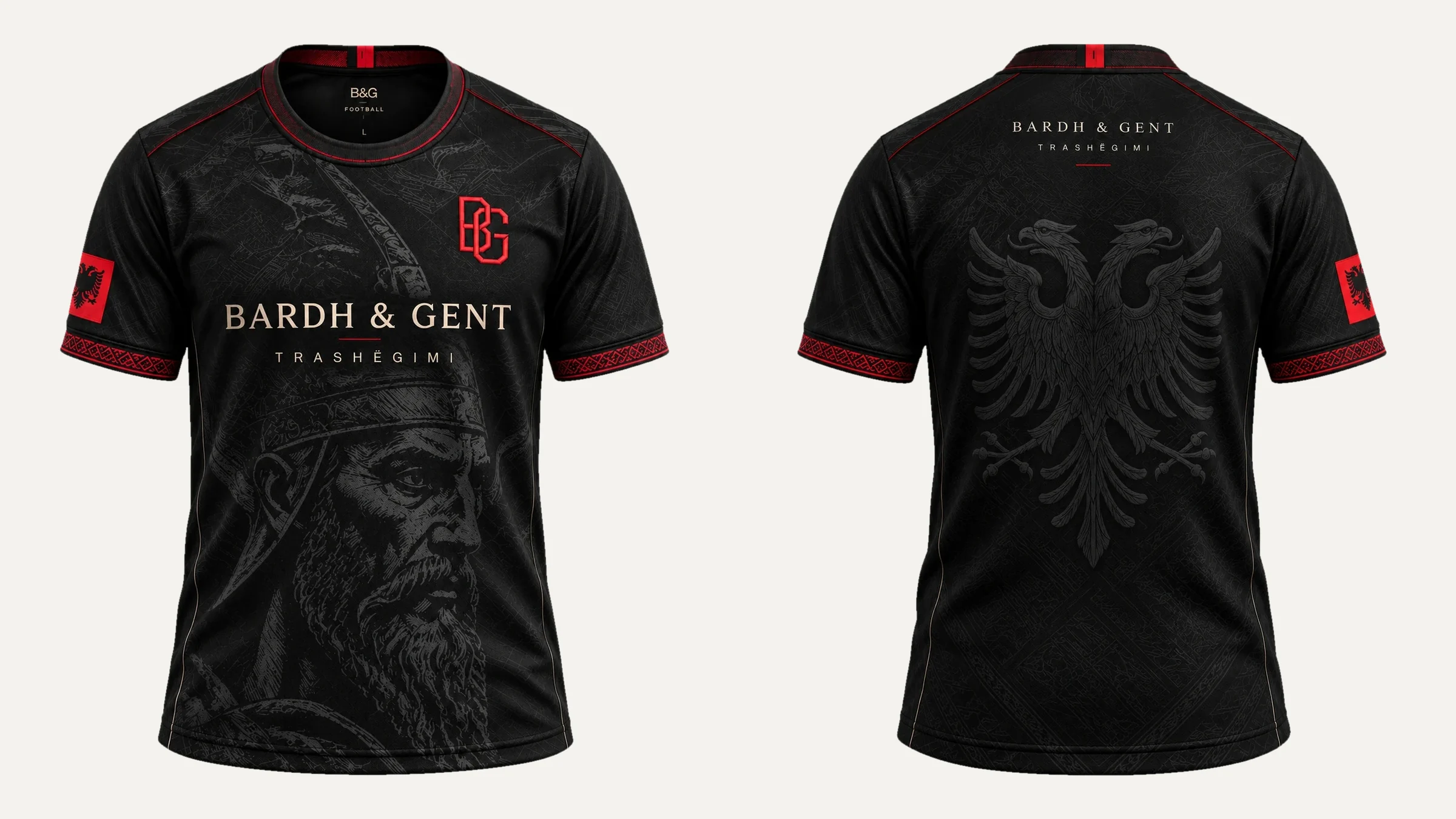

The B&G football shirt in black and white: Skanderbeg engraved on the chest, the double-headed eagle on the sleeve. Our own artwork, numbered.
SEE THE SHIRT →Who was Skanderbeg?+
Gjergj Kastrioti, called Skanderbeg (around 1405 to 1468), was an Albanian nobleman and commander. After twenty years in Ottoman service he led the League of Lezhë against the Ottoman Empire from 1444 until his death. Today he is Albania's national hero.
Why is he called Skanderbeg?+
The Ottomans called him Iskender Bey, Lord Alexander, after Alexander the Great. Skanderbeg, in Albanian Skënderbeu, comes from this.
What was the League of Lezhë?+
An alliance of Albanian noble families founded in Lezhë in March 1444 under Skanderbeg's leadership. It was the first time the Albanian principalities fought together against the Ottomans.
Where are Skanderbeg's helmet and sword?+
In the Imperial Armoury of the Kunsthistorisches Museum in Vienna, where they have been since the late nineteenth century.
- Wikipedia: Skanderbeg
- Wikipedia: Siege of Krujë (1450)
- Wikipedia: Siege of Krujë (1477–1478)
- Wikipedia: Marin Barleti
- Wikipedia: Skanderbeg Monument
- Library of Congress: Albania's National Hero Scanderbeg
- Kunsthistorisches Museum Wien: Skanderbeg, Imperial Armoury
- Kunsthistorisches Museum Wien: Skanderbeg-Helm (Objektseite)
- Tirana Times: Skanderbeg's helmet and sword back home
Why does the Albanian eagle have two heads, what does shqiponja mean, and how did it get onto the flag? From Byzantium via Skanderbeg to today.
READ →Dardania was an ancient kingdom and a Roman province in the heart of the Balkans. Who the Dardanians were, what the name means and why it lives on today.
READ →The bell-shaped xhubleta, the white felt plis and the pleated fustanella: three garments of Albanian traditional dress, how they are made and what they mean.
READ →